
Right now, somewhere out in the world, there is a business owner overwhelmed with the decision to redesign his or her website, trying to decide between the relatively new kid on the block, HubSpot’s Content Optimization System (COS), and the King of the Playground, WordPress Content Management System (CMS). It’s because of this and the fact that we, as a marketing agency, are constantly being asked by clients to weigh the pros/cons/project viability of the two, that I have decided to put my thoughts to pen. So buckle up, folks.

It’s no surprise Stratus is a huge advocate of HubSpot’s COS platform (shocker right?). But, like so many modern web developers, we also design and develop plenty of websites using the WordPress platform. And frankly, our love for WordPress knows no bounds.
This is where it gets interesting.
Just because a website design firm is a HubSpot partner (like Stratus), doesn’t mean HubSpot COS is the only platform suitable to build a custom website. Generally speaking, skilled design agencies can create virtually any website your heart desires in a multitude of reputable development platforms. Choosing a platform should be based on the website’s (or company’s) specific goals, aspirations and needs. Sometimes a client has a preference and sometimes they don’t, but the agency should always be capable of recommending the superior platform for the job. And most importantly, a client should never feel pressured into a particular web platform if they don’t feel like it meets their company's needs.
So, if you're ready to end the HubSpot COS vs. WordPress conundrum, keep reading to understand more about the benefits and value of each. You may be surprised and may even find yourself leaning towards a direction opposite of what you came in here reading.
Benefits of HubSpot COS Design:
-
Easy Site Management
HubSpot’s COS is an extremely easy and intuitive site editor with a robust interface. So naturally, for a marketer like me with barely no HTML knowledge, it’s pretty freakin-fantastic. The use of templates and custom modules allow design teams to develop a site that enable marketers to easily tweak a word here, remove a page there...and so forth.
-
“Smart” Content
With HubSpot’s COS, personalization is no longer out of reach, but available at the click of a single button! Dare I say this is a marketer’s personalized dream. Your website visitors aren’t one-size-fits-all, so having the option treat them like true individuals is a powerful advantage, and one of the reasons I personally think COS has a clear competitive advantage for many website projects. HubSpot’s COS platform allows you to personalize content anonymously, or for known visitors, on any page of your website based on information provided by the visitor. For example, if a visitor previously visited your site and filled out a form, the HubSpot system recognizes them and uses a tool to generate a personalized message. In this case, they’d use their name as the personalization token.
-
Mobile Responsive
No doubt, one of the most important features of HubSpot’s COS is mobile responsiveness. This is crucial to have, especially since Google’s recent mobile-friendly search ranking algorithm which penalizes any non-responsive website in mobile search results. Instead of wasting valuable time of having to manually code the site to enable basic mobile responsiveness, COS does it for you. That’s it, end of story.
-
Built-in Social Features
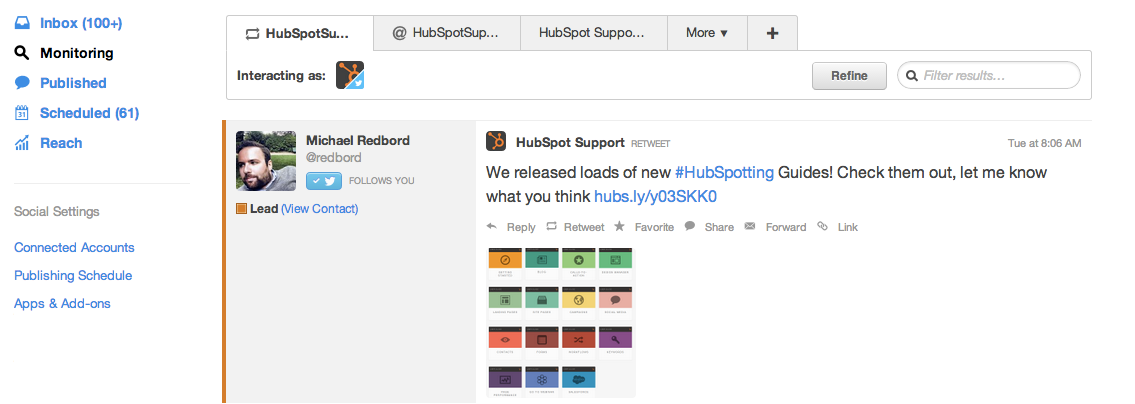
It’s probably safe to assume that your business is using at least one social media platform. And if that’s the case, you probably want to know what your customers and leads are saying about you on those platforms, right? The beauty of HubSpot’s COS is that it allows you to easily integrate all of your social media accounts into the same system so you can streamline what you publish, prioritize your engagement and form a comprehensible report. For example, the Google+ social features help your website gain SEO benefits, while the Twitter card integration allows your blog to take advantage of the summary view in Twitter streams without taking the time to integrate it into the COS. Super beneficial for building your Twitter following!
Benefits of WordPress Design:
-
HubSpot Forms
HubSpot has a plug-in for WordPress so you can easily embed your HubSpot lead forms on your webpages. Equally exciting, you can also include a HubSpot subscription form code inside your WordPress sidebar so prospects can subscribe to your awesome blog (you do have one, right?).
-
Analytics
Integrating WordPress Design and HubSpot is as easy as pasting HubSpot’s JavaScript tracking code into the footer of your WordPress theme. Then, you’ll be able to receive full access to all reporting and analytics tools that HubSpot offers. Boo-yah! On the other hand, if you aren’t a HubSpot customer, you’ll still be able to reap these benefits! There are an abundance of web analytic software plugins that allow you to know where your traffic is coming from and the action of your visitors.
-
Customization
Many of the options where you absolutely need to work directly with your data, such as e-commerce, high-traffic and integrated solutions (working with multiple 3rd party services), will demand a build like WordPress. This is because of the open source nature that allows you to work with and modify your database and server directly. There are quite literally countless third-party WordPress plugins available at arms reach to expand the functionality and customization of a WordPress site, like shopping carts, member only access, etc.
-
Ease of Use
And finally, it’s ease of use! Just as HubSpot’s COS allows you to create templates, you can create a WordPress Design environment through the use of templates that allows you to easily maintain the website yourself (or train others on your team) how to add/delete web pages, product categories, images, etc.
And there you have it. At the end of the day, your goal should be creating a website that bridges the gap between your sales and marketing and serves as a valuable sales tool for your organization. Your website should be your number one salesperson, regardless of which platform you are operating from! Whether you’re HubSpot COS’ biggest fan, or a die-hard WordPress advocate, there are valid arguments for both platforms. If you’re ready to see if your website needs some tender loving care, download our free guide below and figure out the most logical starting point for your redesign game plan!
