
How much is a keyword worth to your business? It’s an arbitrary question, but one that must be answered. If you own an online clothing store do you make more money from customers searching “blue jeans” or “white shirts?”
If you’re not savvy to tracking these types of metrics then this blog is for you. 
Keyword development (or research) tools, such as HubSpots Keyword Tool, allows webmasters to uncover search volume for key terms so that you can focus your efforts on the search terms producing the best results for your company and essentially the ones creating remarkable sales results.
I tapped the knowledgebase of Stratus Interactive resident SEO expert, Brett Robinson to shed some light on the process of developing keyword lists and figuring out the true value of a keyword research and keyword development.
Why do you need keywords in order to have a succesful business?
There are many reasons, but for starters, every day billions of queries are typed into search engines using keywords and phrases to find information, to make transactions and to find particular destinations. To return search results that are relevant to each specific query, engines rely on indexed web pages that their bots have crawled.
For the bots to comprehend what each web page is about, it uses the keywords and phrases in the content to formulate an understanding. So keywords send signals to search engines so they can understand what your content is about, then serve up the most relevant results based on their index.
So how do I ensure that my website ranks?
If you want your page to rank, you need to let search engines understand what your page is about while focusing on making each of your pages valuable to your users.
How do you use the HubSpot Keyword Tool on a daily basis for clients?
I generally do not check keywords on a daily basis.
Why is that?
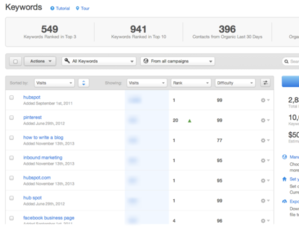
Checking daily is a very shortsighted approach. Ranking for keywords is a long-term approach and jumps in ranking generally do not happen overnight to the dismay of marketer's everywhere. However, I do monitor keywords weekly to check on improvements or erratic declines in ranking for certain terms. This is especially important when the king of all search engines, Google, makes an update to their algorithm to ensure nothing drastic is happening to our clients ranking.
In terms of how I use the Hubspot Keyword Tool, I find checking the current rank fairly consistently gives a quality overall view of how each specific keyword is performing.
What’s your plan when you find a keyword you want to focus on?
For keywords that I want to attack, I find that the difficulty score and monthly search volume features are extremely helpful. Finding that perfect balance between monthly search volume and normalized difficulty is a tough feat given the ultra competitive SEO landscape. However, broadening your keyword base to include various long-tail keywords with lower difficulty scores is essential in getting your company found by searchers.
What are the different types of keywords?
There are really only two different types of keywords; broad and long-tail.
Broad keywords include terms like SEO or Marketing and are generally extremely difficult to achieve a high rank on the SERPS if your website does not have a high domain authority and tons of traffic.
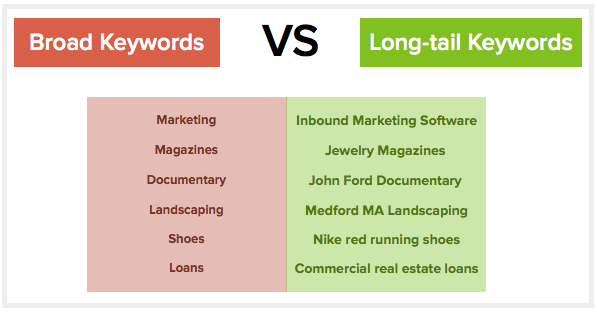
Long-tail keywords are more specific in nature and include some context like Top SEO Firms or Inbound Marketing Software. Searchers are increasingly searching for long-tail keywords so although the search volume might be drastically lower, your chances of ranking and being found by your customers is significantly increased.
If you had your choice would you rather use your resources to go after a long-tail keyword with a low difficulty or a high traffic keyword with high difficulty?
It really depends on the company and website I am working with.
How about for a smaller client?
For smaller clients, going after a laundry list of long-tail keywords is the necessary approach so I can start building organic traffic. With our larger clients that receive thousands of visits to their website per month, I am more inclined to go after higher volume terms so I don’t spread their organic search too thin.
With that said, we have a big client that was only going after broad keywords and not driving the highest quality leads to their website. So, while we did not neglect those broad keywords, we started finding more long-tail opportunities that we could rank higher for, and the result was the company jumped up to #2 on the SERPS for every term we went after.
Their organic traffic has been consistently improving every month while driving highly qualified leads to their website. That’s what SEO is all about!
What are some tips you can share with other marketers when developing a list of initial keywords?
Hubspot actually has a fantastic worksheet to help organize and generate keywords; I would highly recommend using it.

After you have generated a long list, pop the list into Adwords or the Hubspot Keyword Planning tool to find out the monthly search volumes and the difficulty score.
Then, formulate your strategy from there!
--

Of course if you have any additional questions please leave them in the comments below or email Brett directly at brobinson@stratusinteractive.com