
The term Inbound Marketing is flying around today and there are plenty of people who may find themselves a little lost. If you were to search Google for some answers, you may find your results are too broad or generalized. So, inbound marketing is through social media and blogs and other outlets? That's correct, but it doesn't tell you how. It doesn't tell you why. And it certainly doesnt explain how necessary it may be for your business today.
"If you have more money than brains, spend it on outbound marketing. If you have more brains than money, spend it on inbound marketing." -Guy KawasakiHave your brain check out this step by step inbound marketing process.
1. Create A Marketing Strategy That Fits You AND Your Business
First you need to establish a plan. What are your goals as a business, where do you see (or where do you want to see) yourself five years from now. What kind of challenges will you face to obtain that goal?

Another helpful tip in establishing a marketing plan is researching what your audience looks like. Who are your potential buyers and how are they accessing your company's information? You need to pay attention to this, as narrowing your focus will increase your chances at a quality lead.
Inbound marketing is obviously less expensive than outbound, as a majority of it is handled through social media. So it makes sense that, if successful, it could have an influence on your ROI.
Your marketing plan needs to be centered around improving your ROI.
2. If Looks Could Kill... Your Website Would Be Wanted
First impressions matter, and if your site's still partying like it's 1999, don't expect your leads to funnel into sales. Ideally, your website needs to:
- be simple to navigate through (shooting for minimal confusion, here)
- portray itself professionally, in both tone and appearance
- implement SEO techniques (we'll get to that)
3. Be Lean, Be Mean, Be A Traffic-Generating Machine
- Social Media
- Build your following
- Share articles, blog posts, behind-the-scenes of your business
- Engage in social media conversations, as people will be more likely to follow you if you have something to say (that old adage of missing 100% of the shots you don't take comes to mind)
- Blogging
- Produce interesting/worthwhile articles
- Each blog post is another page added into search engines
- A blog could also bring up to 55% new traffic (but it takes some work)
- Search Engine Optimization (SEO)
- You need to optimize your website so information is accessed easily by Google
- Check your indexing status (Google Webmaster Tools)
- Focus Your Site On Targeted Keywords
- Provide Quality Inbound Links
4. Turn Your Traffic Into Leads...
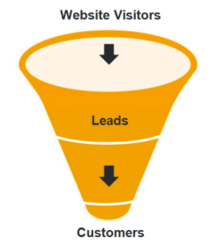
Use TOFu's, MOFu's, and BOFu's (more achronyms, I know)
That'sTopof Funnel,MiddleofFunnel, andBottomOf Funnel offers.
So, what exactly does that mean? Your offers need to be structured based on the phase of the buying process your leads are currently in.
- Create content/landing pages that provide offers juxtaposed with forms the visitor needs to fill out.
- Upon completion, the visitor will obtain access to said-offer, and you, as a business, should obtain an email listing.
- Place CTA's strategically throughout the site to encourage potential leads to send you their information.
5. And Turn Those Leads into $$$
It's the reason we're here, after all. Be effective and make sure you aren't letting any of your leads go unattended for too long. Understand that organization is key, and in order to be effective, you need to make sure you're putting in the effort to translate business into profit.
Some Key Takeaways from around the industry:
Lead Intel- Know what pages your leads are viewing and when they return, know who you need to contact first.
Segment Leads- Segment your leads and clients into lists, that way you're able to send targeted emails or messages that relate to each business.
Nurture Them Too- Various leads nurturing campaigns developed to further educate "top of funnel" leads down into sales.
And last but not least...

What are the some of the most important metrics that you need to be measuring?
traffic to leads/leads to customers/cost per lead/cost per customer
This is an important last step, as it's paramount that you alter your business model if you aren't seeing the results you anticipated. Not every model works for every business, so statistics and analytics need to be a part of the process, and don't be afraid to change it up; many of the world's greatest ideas are the direct result of its greatest mistakes. Remember this (and everything else you've learned), and you'll be an Inbound success story.